01 / Geological family
Origin and composition
- Geological family
- Metamorphic
- Origin and composition
- calcitic, calcite-dolomite and dolomitic marbles
- Origin
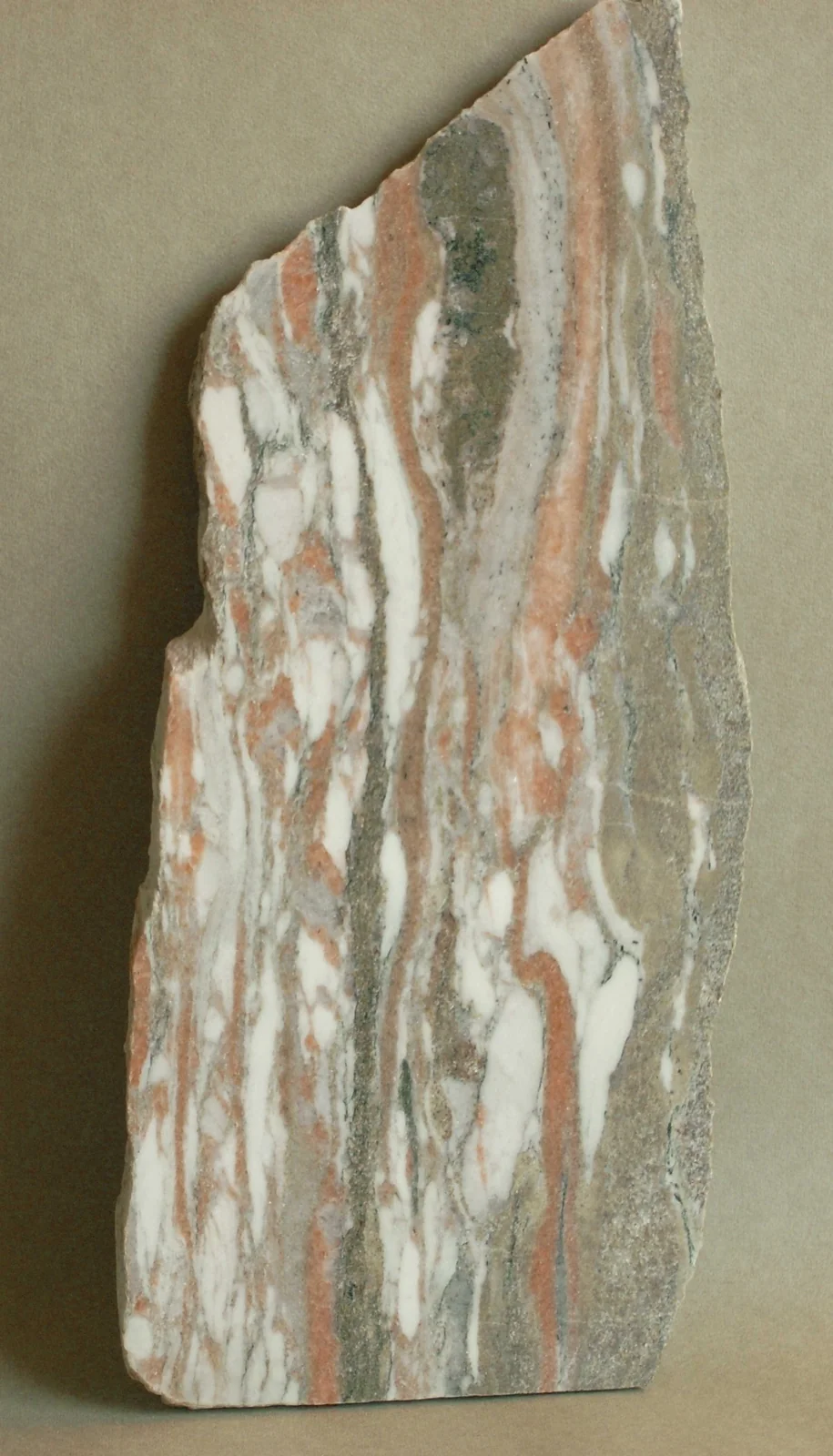
- Fauske, Nordland, Norway
- Appearance and identification
- white, grey, pink, green and pink-white banding
Metamorphic rocks result from existing rocks changing under new pressure, temperature and fluid conditions. Marbles and quartzites can show recrystallised textures; gneisses, slates and phyllites often show oriented minerals and recognisable planes. These structures matter for cutting direction, thickness and interpretation of mechanical tests. Metamorphic origin alone does not establish suitability: composition, weathering and processing remain decisive.
02 / History and curiosities
History and curiosities
Norwegian Rose and Koloritt illustrate the district’s commercial variety.
03 / Applications and design
Applications and design
walls, floors and ornamental details.
Finishes and processes ↗04 / Technical interpretation
What to ask your supplier
Identify the variety and band orientation; the district is not one uniform stone.
05 / Care and maintenance
Care and maintenance
Remove dust and grit with soft tools, wash with a compatible neutral cleaner, then rinse and dry. Identify composition before using stain or scale removers: carbonate stones are acid-sensitive. Test every treatment in an inconspicuous area. An impregnator can reduce absorption but does not make a material waterproof or stain-proof.
Thoughtful cleaning, protection and maintenance ↗07 / Sources and further reading


